
Table of Contents
ToggleIndoor bulbs offer a workaround for gardeners who don’t want to wait for spring. These compact powerhouses store everything they need to produce flowers, making them surprisingly forgiving for beginners. Unlike seed-grown plants that require weeks of careful tending, bulbs come pre-loaded with energy and a genetic roadmap to bloom. Whether it’s forcing paperwhites for winter fragrance or coaxing amaryllis into December color, growing bulbs indoors gives homeowners control over timing and environment. The process isn’t complicated, but it does require attention to a few non-negotiables: proper chilling periods for some varieties, correct planting depth, and consistent moisture without waterlogging.
Key Takeaways
- Growing bulbs for indoor plants eliminates dependence on outdoor conditions and allows precise control over bloom timing, letting gardeners enjoy tulips, daffodils, and hyacinths in winter.
- Most spring bulbs require a cold chilling period of 12–16 weeks at 35–45°F to trigger flowering, while paperwhites and amaryllis bloom without refrigeration.
- Use containers with drainage holes and well-draining potting mix or gravel-and-water setups to prevent bulb rot, the most common cause of failure.
- Plant bulbs with the pointed end up, just below the soil surface, and provide 6–8 hours of bright, indirect light daily once shoots emerge for strong, straight stems.
- Keep soil consistently moist but not waterlogged, maintain temperatures between 60–68°F during the day, and avoid overwatering—the fastest way to kill indoor bulbs.
- Select firm, heavy bulbs with intact papery skins and avoid compact varieties for small spaces to prevent the need for staking and ensure reliable blooms.
What Are Indoor Bulbs and Why Grow Them?
Indoor bulbs are underground storage structures, technically called true bulbs, corms, tubers, or rhizomes, that contain all the nutrients and embryonic flower parts needed to produce blooms. Popular examples include tulips, daffodils, hyacinths, amaryllis, and paperwhites. Unlike typical houseplants that grow continuously, bulbs follow a predictable cycle: growth, bloom, dormancy, and regeneration.
Growing bulbs indoors offers several practical advantages. First, it eliminates dependence on outdoor conditions. Someone in a Chicago apartment can enjoy tulips in January without waiting for the ground to thaw. Second, indoor growing allows precise control over bloom timing, useful for holidays, events, or simply breaking up the monotony of gray winter months. Third, many fragrant indoor plants like hyacinths and paperwhites deliver intense scent that permeates a room, something most foliage houseplants can’t match.
The tradeoff? Most spring bulbs need a cold period (called vernalization) to trigger flowering. This means refrigerating them for 12–16 weeks before planting. Not all bulbs require chilling, amaryllis and paperwhites will bloom without it, but understanding each variety’s needs is critical to success.
Choosing the Best Bulbs for Indoor Growing
Not all bulbs adapt well to indoor conditions. The best candidates fall into two categories: those that require chilling and those that don’t.
Bulbs That Need Chilling (12–16 weeks at 35–45°F):
- Tulips: Choose shorter varieties like ‘Red Riding Hood’ or species tulips: tall types can get leggy indoors.
- Daffodils and narcissus: ‘Tête-à-Tête’ and ‘Jetfire’ are compact and reliable.
- Hyacinths: Extremely fragrant: ‘Carnegie’ (white) and ‘Delft Blue’ are popular.
- Crocuses: Small and early: need only 8–10 weeks of chilling.
Bulbs That Don’t Require Chilling:
- Paperwhites (Narcissus papyraceus): The easiest option. Plant anytime and expect blooms in 3–5 weeks.
- Amaryllis (Hippeastrum): Large, dramatic flowers. One bulb often produces multiple stalks.
- Freesia: Fragrant but needs bright light and cooler temps (60–65°F) during growth.
When shopping, select firm, heavy bulbs with intact papery skins. Avoid any with soft spots, mold, or visible damage. Larger bulbs generally produce more or bigger flowers. If buying pre-chilled bulbs from a garden center in fall, confirm they’ve completed the required cold period, some are sold “ready to plant,” while others still need refrigeration.
As noted by Country Living, smaller spaces often benefit from compact bulb varieties that won’t topple without staking.
Essential Supplies and Containers for Indoor Bulb Growing
Indoor bulb growing doesn’t require specialized equipment, but a few deliberate choices make the difference between thriving blooms and disappointment.
Containers:
Any container works as long as it has drainage holes. Bulbs sitting in water will rot within days. Decorative ceramic pots are fine if paired with a plastic liner that drains. For paperwhites and hyacinths, shallow bowls (4–6 inches deep) are sufficient since roots don’t need much space. Amaryllis prefer pots 1–2 inches wider than the bulb diameter: too much room leads to excess foliage at the expense of flowers.
Forcing vases, narrow-waisted glass containers that suspend bulbs above water, work well for hyacinths and allow root observation, which appeals to kids and first-timers.
Growing Medium:
Bulbs can grow in soil, soilless mix, or even gravel and water. For soil-based planting, use a well-draining potting mix, not garden soil, which compacts and holds too much moisture indoors. A mix labeled for succulents or cacti works well.
For water and gravel setups (common with paperwhites), use clean pea gravel, marbles, or decorative stones. Fill the container so bulbs sit on the surface with roots reaching water below. The bulb base should not be submerged, only the roots.
Materials Checklist:
- Bulbs (pre-chilled if needed)
- Containers with drainage or forcing vases
- Potting mix or pea gravel
- Watering can with narrow spout
- Optional: bulb fertilizer (low-nitrogen, like 5-10-10)
- Optional: bamboo stakes and twine for tall varieties
Skip the fertilizer for paperwhites and other single-season bulbs that won’t be saved for replanting. They have enough stored energy to bloom once without supplemental feeding.
Step-by-Step Guide to Planting Bulbs Indoors
Planting bulbs indoors is straightforward, but precision with depth and spacing prevents issues later.
For Soil-Based Planting:
-
Fill the container: Add potting mix until the container is about two-thirds full. Lightly tamp down to eliminate air pockets but don’t compress it.
-
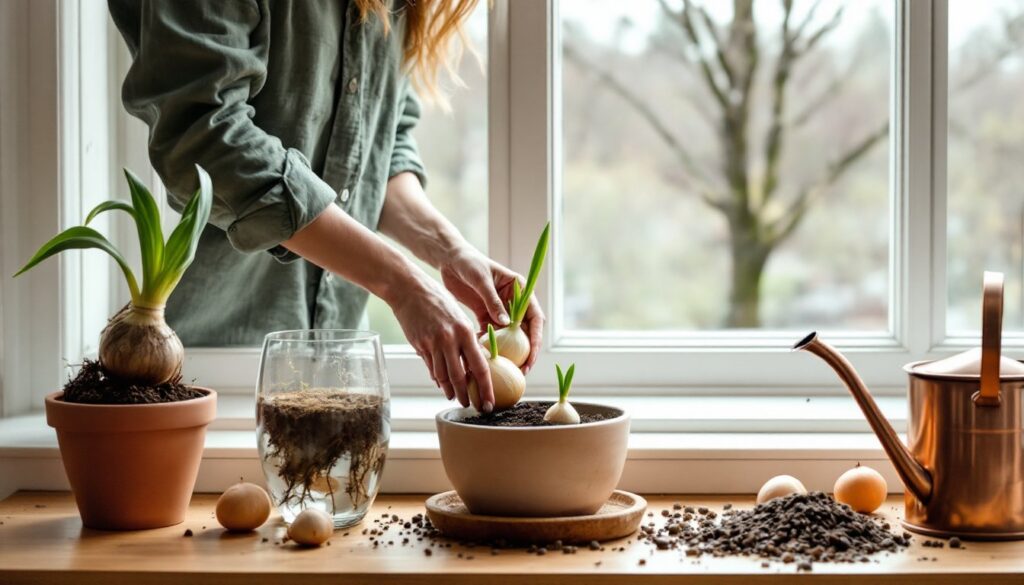
Position the bulbs: Place bulbs pointed end up, flat end (root plate) down. For most bulbs, the tip should sit just below the soil surface or slightly exposed. Tulips, daffodils, and hyacinths: Plant so the top third of the bulb is visible. Amaryllis: Leave the top half exposed. Space bulbs close, almost touching, for a full display. They won’t mind crowding during a single season.
-
Add more soil: Fill around the bulbs, leaving tips exposed as noted above. Gently firm the soil.
-
Water thoroughly: Water until it drains from the bottom. Soil should be evenly moist but not soggy. Don’t water again until the top inch feels dry.
-
Initial placement: For chilled bulbs, place the container in a cool, dark location (50–60°F) for 2–3 weeks to encourage root growth. A basement or unheated garage works. Once shoots appear (1–2 inches tall), move to bright, indirect light.
For Gravel and Water Planting (Paperwhites, Hyacinths):
-
Fill the container: Add 2–3 inches of gravel or stones.
-
Set the bulbs: Nestle bulbs into the gravel, pointed end up, packed closely.
-
Add water: Pour water until it just touches the bulb bases, not covering them. Roots will grow down into the water.
-
Maintain water level: Check every few days and top off as needed. Change the water weekly to prevent algae and odor.
Common Mistake to Avoid:
Planting bulbs upside down. The pointed end is the shoot: the flat, often hairy end is the root plate. If unsure, plant sideways, bulbs will self-correct, though it delays sprouting by a week or two.
Caring for Your Indoor Bulbs: Light, Water, and Temperature
Once bulbs break dormancy and start growing, their care resembles other common indoor house plants, but with tighter parameters.
Light:
Bulbs need 6–8 hours of bright, indirect light daily once shoots emerge. A south or west-facing window works best. Insufficient light causes weak, floppy stems and pale foliage. If natural light is limited, consider using grow lights for house plants placed 6–12 inches above the foliage for 12–14 hours per day. According to The Spruce, fluorescent or LED grow lights work equally well for supplemental indoor lighting.
Rotate containers every few days so stems grow straight rather than leaning toward the light source.
Water:
Keep soil consistently moist but never waterlogged. Overwatering is the fastest way to rot bulbs. Water when the top inch of soil feels dry, usually every 3–5 days, depending on temperature and humidity. For gravel setups, maintain water at the base of the bulb, not submerging it.
Once buds form, increase watering slightly. Flowering depletes moisture faster.
Temperature:
Cooler temps prolong bloom life. Ideal range: 60–68°F during the day, 50–60°F at night. Warmer conditions rush blooms and shorten their display. Keep bulbs away from heating vents, radiators, and direct sunlight, which can spike temperatures.
For paperwhites, a trick to prevent tall, floppy stems: once shoots are 1–2 inches tall, water with a diluted alcohol solution (one part vodka or rubbing alcohol to seven parts water). This stunts stem growth by about one-third without affecting flowers.
Staking:
Tall varieties like amaryllis and some tulips may need support. Insert a bamboo stake near the bulb (avoid piercing it) and loosely tie the stem with twine or soft plant ties as it grows.
Troubleshooting Common Indoor Bulb Growing Problems
Even experienced gardeners hit snags with indoor bulbs. Here’s how to diagnose and fix the most frequent issues.
No Flowers, Only Leaves:
This happens when bulbs didn’t receive adequate chilling (for varieties that need it) or were planted too deep. Double-check chilling requirements before buying. If the bulb has already sprouted, it’s too late to fix this season, compost it or plant it outdoors for next year.
Floppy, Weak Stems:
Usually caused by insufficient light or too much heat. Move the container to a brighter, cooler spot. For paperwhites, switch to the alcohol-water solution mentioned earlier.
Bulbs Rotting:
Overwatering or lack of drainage. If caught early, remove the bulb, trim away soft tissue, dust with sulfur or cinnamon (natural antifungals), and replant in fresh, dry medium. Water sparingly. If rot is extensive, discard the bulb to prevent spreading.
Slow or No Growth:
Bulb may be old, dried out, or damaged. Check firmness, healthy bulbs are solid and heavy. Shriveled or lightweight bulbs lack stored energy. Temperature may also be too cold: roots develop best at 50–60°F, not refrigerator temps.
Short Bloom Period:
High temperatures shorten flower life. Move blooming plants to the coolest room in the house (away from kitchens and sunny windows). Some growers refrigerate blooming bulbs at night to extend display by several days.
Mold on Soil Surface:
Common in damp, low-airflow conditions. Scrape off mold, reduce watering frequency, and improve air circulation with a small fan. Mold on soil is cosmetic and won’t harm the bulb unless it spreads to the bulb itself.
Resources like Hunker offer troubleshooting galleries that can help identify specific foliage or bloom problems.
Conclusion
Growing bulbs indoors strips away the unpredictability of outdoor gardening and puts bloom timing in the grower’s hands. With the right bulb selection, proper chilling (when needed), and attention to light and moisture, even a novice can coax reliable color from a windowsill. The process rewards patience in the early weeks and delivers a concentrated burst of flowers that most foliage plants can’t match. For anyone tired of waiting for spring or looking to add seasonal interest indoors, bulbs are a low-investment, high-impact project.